
Galápagos Islands: North Seymour Island
- Diane Schnoor
- Oct 23, 2025
- 3 min read

In this series of posts, I'd like to take you along with me on a magical Adventure in Learning to the Galápagos Islands. Each post will focus on aspects of the biomes, habitats, plants, and animals that call these islands home. The Galápagos Islands are a magical place where nature has been largely left alone (97 percent of the islands are protected park land) and carefully managed for conservation. They point the way to solutions for some of the difficult conversations we face about conservation, human need and impact, and biodiversity.
Even more than that, this series of posts is about wonder, curiosity, connection, empathy, and learning through play. When I work with adults and children, part of my job is to help the find the spark, the wow moment, the aha that lights you up and gets you wanting to dig deeper, learn more, and create powerful real-world connections. This trip unlocked that same sense of play and wonder for me. I returned energized and ready to bring new stories to my talks, new STEM/STEAM lessons about habitats/biomes, life cycles, and conservation to classrooms and libraries, and new avenues into wonder, curiosity, and empathy to a world that is frankly struggling right now.
So join me on this Adventure in Learning. Post your questions and I'll try to answer them. And enjoy this peek into the Enchanted Islands.


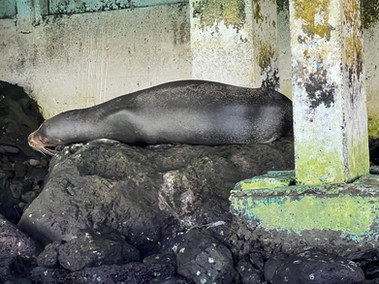
Today was a magical day. We were greeted at Balta airport by a land iguana blocking our path. We had to take a panga or dinghy out to the Galápagos Legend. As we were waiting to board, we turned and saw two sea lions sleeping right under the pier. We also saw bright reddish pink Sally Lightfoot crabs scuttling on the rocks by the landing (and a brown pelican waiting for lunch). On our way over to the Legend, we saw our first blue-footed booby fly and dive into the water and we saw a green sea turtle swimming.

We took a dingy to N. Seymour Island for a golden hour hike. Volcanic cliffs and pumice everywhere -- so much rich red iron in the rocks -- felt a little like walking on a desert island version of Mars. When we arrived, a sea lion greeted us on the rocks. We also heard the chatter of gulls (lava gulls and swallow tails). Frigatebirds (huge wingspans and giant red throat pouches that they inflate) soared over us like pteranodons -- Jurassic Park come to life.
We went inland to visit the blue-footed booby colony first. So many chicks out and about in varying stages of fuzzy cuteness. We saw a chick still completely white and downy, maybe a few days old and then saw them progressively age up to about 8 weeks. At one point we saw a blue-footed daddy feeding a chick. The nests are circles of the parent boobies own guava or poop. We even saw a booby daddy sitting on two eggs and guarding them from the piratey frigatebirds nearby.


We saw the mating rituals of the magnificent frigate bird. The male has a giant red balloon of throat pouch he inflates to try to impress the ladies. Both the magnificent and great frigatebirds are huge pirates who steal food from other birds at every opportunity. The great frigatebird is smaller than the magnificent frigatebird (sounds like a math equation: good < great < magnificent < ???). The adult great frigatebird also has a greenish tint to its feathers instead of the purplish gloss of the magnificent frigatebird. Young frigatebirds have a LOOOOOONG and awkward adolescence. They can take 8-10 years to mature!!!! You can tell the adult frigatebirds by their scissor tails and huge wingspans. They can reach speeds of 100 mph and are able to maneuver to grab fish or pirate food without having to land. Frigatebirds practice kleptoparasitism (pirating) — they watch for incoming bird traffic then extract a toll of food.


Along with the frigatebirds, we saw land iguanas. We also saw cactus where the land iguanas had crawled up and taken a giant bite out of the top. Closer to the shore, we saw a small black marine iguana clinging to the rocks. We also saw lava lizards, basking in the sun with their crimson crests.


The sea lions were just beginning to come ashore. We saw some darling pups yipping at each other, while the moms crashed hard on the rocks. We also heard the bark of the bull sea lions from the water.